
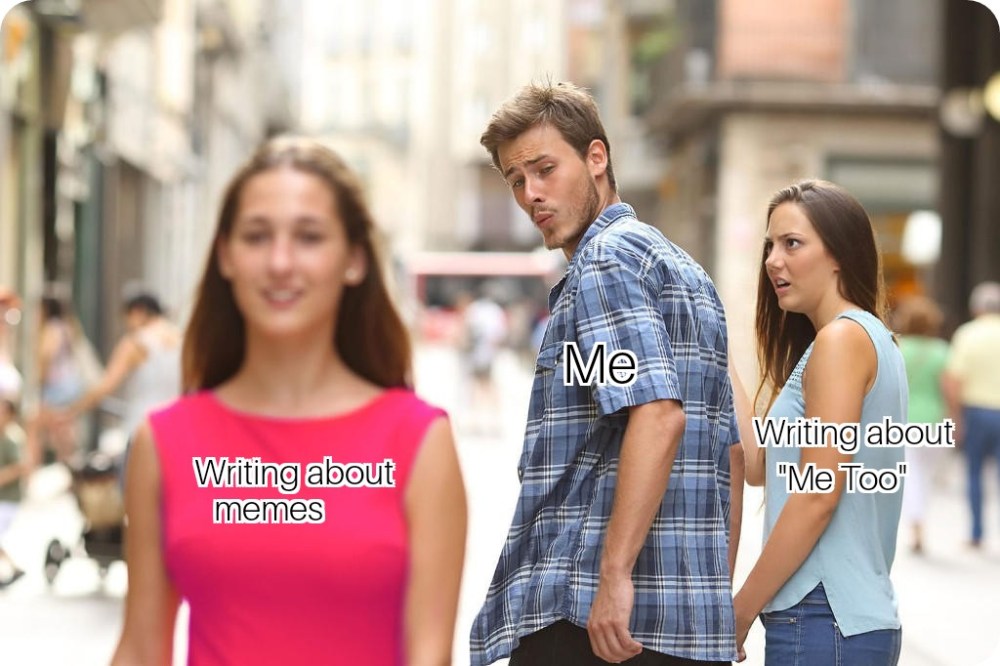
 Author’s Note: I would like to call this my first “research paper”, for I have spent several weeks contemplating the various points of this study. All the points in this piece are purely a work of my own intellect–I brainstormed until I managed to come up with logical conclusions to my claims. Do stick around till the end and provide feedback on how this work influenced you.
One drowsy summer afternoon, a geeky young boy was sitting in his room, browsing the new world–the Internet. The net had opened up so many new avenues for business, research and development. However, the thing that appealed the most to this boy was the Internet’s freedom. He could take any picture, modify it, and claim the new picture as his own creation. The boy was already a movie geek, and was up-to-date on the latest trends. So, he attached a caption– a famous pop culture reference– to one such modified picture and posted this on the Internet. And just like that, the world’s first meme was created.
It’s pretty safe to say that memes have taken the world by storm. The memeing culture rose partly due to the Internet’s loose copyright laws. Memes were incredibly successful because anyone could find them anywhere on the net. Books, music and movies have influenced pop culture for years, but there is one key difference between them and memes–memes are free. Memes are not a judgement of your social standard or your success; they are enjoyable because of their relatable nature. Everyone can understand memes(except normies). The memeing culture is based on a sense of collective ownership, which is what makes memes so appealing. You could be a waiter in a New York eatery or a white collar clerk in upscale London or a millionaire Machiavellian in Mumbai, and you will still be able to relate to memes. This occurs mainly because memes can define things we can’t express very well through words. I conducted a social experiment to test this notion. I explained my teacher’s reaction to a stupid question verbally to a group of my friends, and they ‘got’ the joke in his response to varying degrees of understanding. I followed this up by showing them a meme describing the same event and they all cracked up. This can be explained using two different methods. The first method argues that one can attribute the success of memes in explaining things to their visual characteristics. It’s always easier to understand something if it is being displayed to you. You’ll view the image and suddenly your brain will be able to comprehend raw facts, and you will ‘get’ the meme. The second method argues that seeing a meme reminds you of an earlier meme and this, combined with your thoughts associated with the current meme, make you laugh.
I am certain that memes will be this generation’s greatest legacy to the pop culture world. But more than just defining and explaining what a meme is, I wanted to dive deep into the roots of the meme culture. I wanted to find out why memes are so appealing. After some brainstorming, I came up with a hypothesis.
My hypothesis bases itself on the assumption that memes are born due to the influence society has on the meme creator. It is a common assumption that memers are lonely, depressed people who fear interaction with others and make memes to see if they can make strangers happy. As a memer myself, I can confirm this. They joy we memers get from making other people laugh knows no bounds. Every time someone reacts to one of our memes, our perception of ourselves becomes more positive. This may be attributed to the fact that most meme creators are introverts and any sort of interaction with strangers boosts our self worth.
While coming up with this theory, I was up one night at 2 AM, sipping my coffee and reviewing possible points for my hypothesis. It was around this time that I stumbled upon a huge realisation. Memes do not just reflect societal trends–they portray society itself.
Think about it for a minute. Memes are extremely successful not only because they make you laugh, they also appeal to the broken soul inside you and your disappointment with society’s unspoken rules. Take meme templates, for example. A meme template is a picture that is used as the base of a meme. You can change the text and other minor details of the picture to make new memes. What if this represented society? Firstly, just like meme templates, humans also follow the template society gives to them. What if this was a result of humans living the exact same lives and trying to make something new out of our lives even though everyone’s lives are more or less the same? Is it because we’ve subconsciously accepted that society will force us to live the same life as someone else?
Secondly, just like how different memes are formed from one meme template, many people share uncannily similar backgrounds. Thirdly, we are only allowed to change certain characteristics in the meme template to create a new meme, and similarly humans are only provided with so much wriggling room in their pursuit of a unique personality. Trying to incorporate major changes in your ideals is frowned upon by society. Also, meme templates are often reused over and over again, and the same thing happens in society too. The same societal blueprint is forced onto many people. It’s almost as if something sinister was running the world from behind the scenes and that an all powerful organisation was controlling us and making us all do the exact same thing (Illuminati Confirmed). Another interesting thing is that just like there are different meme templates with each template containing several memes, society is divided into classes and each class has its own template, its own people. And just like how all the various templates eventually contribute towards the meme economy, the various classes work together to keep the machinery of modern life running.
Additionally, whenever a new meme template rises in popularity, we are overjoyed because we have more opportunities to create new memes. This occurs because this template broke the monopoly of the current meme trends and breathed fresh life into the meme economy. Similarly, people are overjoyed when they see someone go against societal norms and still be successful, for this person inspires those who failed trying to cross this obstacle and those who were aspiring to do the same. This person then becomes a role model for many because he broke society’s monopoly over the rules of life.
Also, certain shows and personalities have always dominated the meme landscape. Spongebob is arguably the most memed TV show in history, and Gordon Ramsey is one of the meme icons of the world. Celebrities have always been a big part of the meme world. Isn’t this an accurate portrayal of life too? Certain big companies have a monopoly over the market, and celebrities are the biggest public influencers. It’s almost as if power and fame guarantee you success in any field, be it memes or real life.
It is evident from the above assertions that memes have a much deeper origin story than most would have imagined. There is a distinct possibility that memes are actually a way of laughing at ourselves and our inability to break free from society and its peer pressure and conformist mindset. Now that I’ve stated what a meme is, why memes are successful and what their origins are, I will address the elephant in the room. Why is any of this important?
Most humans have self doubt–they keep wondering if they are good enough to deserve something. Over time, this self doubt eventually evolves into a feeling of being unloved. We start to assume that everybody dislikes us. It is due to this that we laugh at memes online. When we laugh at a meme, we feel that we are a part of something bigger. We feel that we are a part of a shared joke and are part of a community that enjoys such jokes. To put it simply, memes create a sense of belonging in people. We can identify hints of ourselves in complete strangers on the net. We start to feel wanted, as we are part of an online community of like minded people who can understand your plight. This increases our self worth and makes us feel good about ourselves.
Scrolling through a social media feed filled with memes is today’s generation’s way of relaxing. No matter how lonely or depressed or unloved you feel, a meme will always cheer you up. Sometimes, memes on certain topics inspire memers to get to know more about these topics, and this does more good than harm. Indeed, there have been instances where memes on depression motivated people to fight depression and eventually overcome it.
Memes form the glue that holds us together despite all the negative things going on in our lives. They are a momentary escape from the struggle of life and have a light-hearted way of looking at things. Without the cheerfulness memes give us on a daily basis, our lives would be meaningless, or rather, memeing-less


Which teacher and which reaction are you talking about
LikeLike